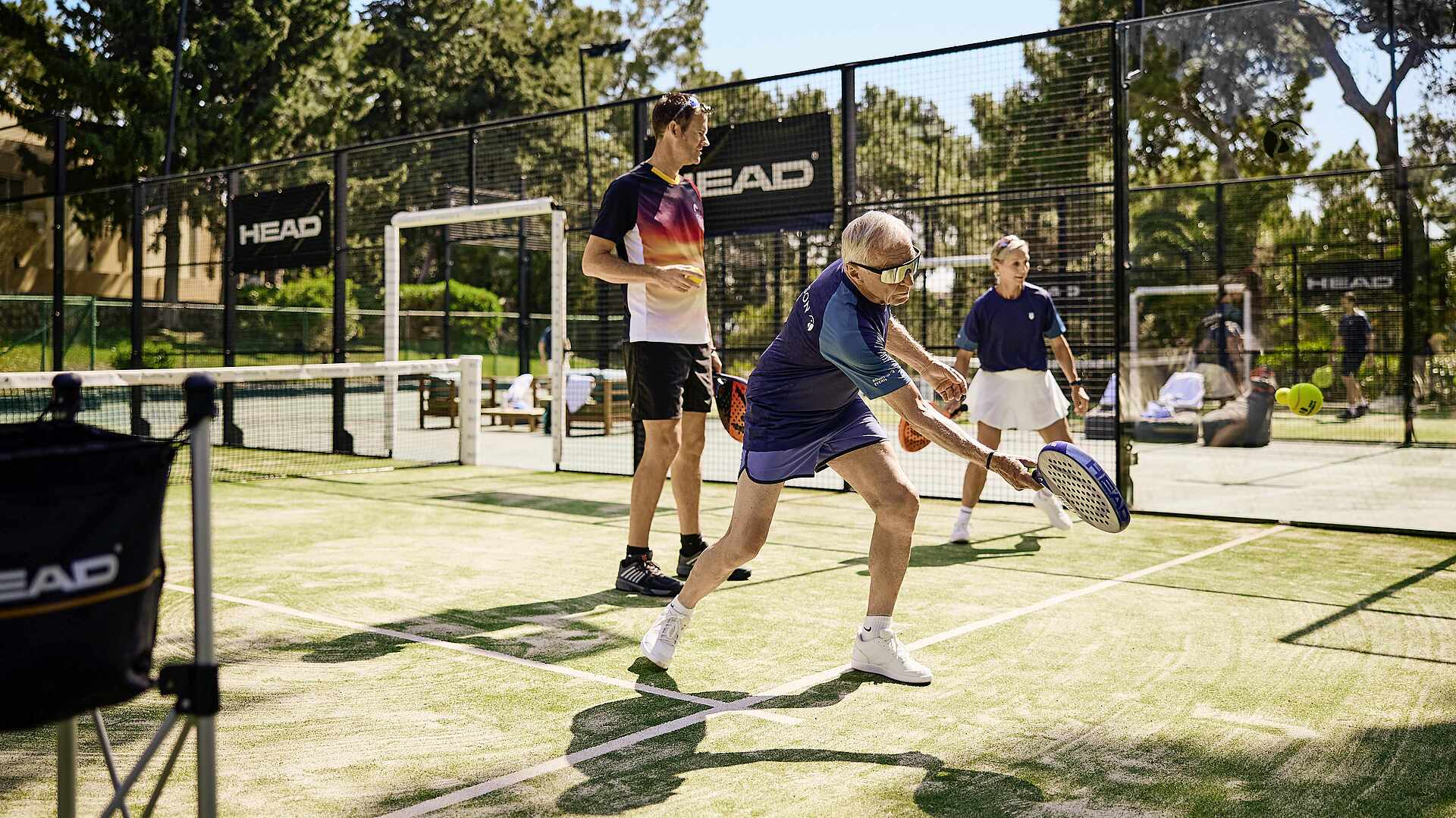
Padel
In trend: This is why you absolutely have to try padel tennis.
Many sports claim it, but with padel it's definitely true: padel is easy to learn, padel is a lot of fun and padel is a wonderful team sport because it's always played in doubles. Three unbeatable arguments for padel. It's only logical that padel is now also played at ROBINSON.
Where does padel or padel tennis come from?
History: Mexico, 1965. The desire to have one's own tennis court on the estate. But what if there wasn't enough space? So the first padel court was built in the middle of Acapulco's hot sun - rather by chance. Surrounded by concrete walls that could be skilfully integrated into the game.
How do you play?
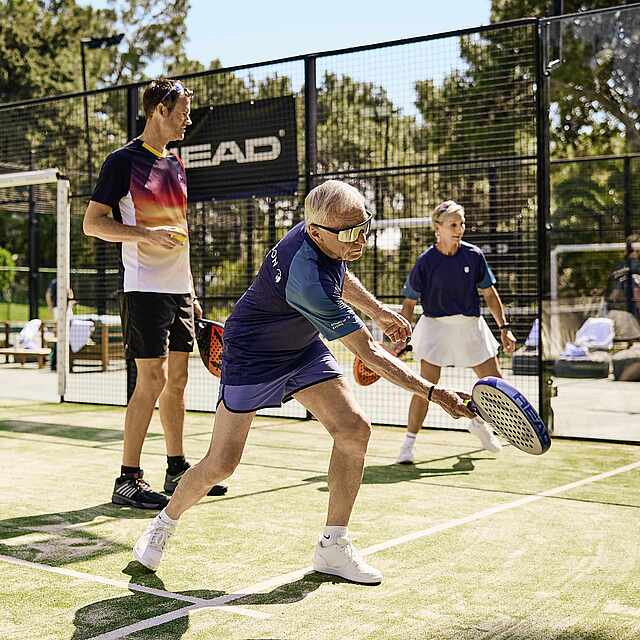
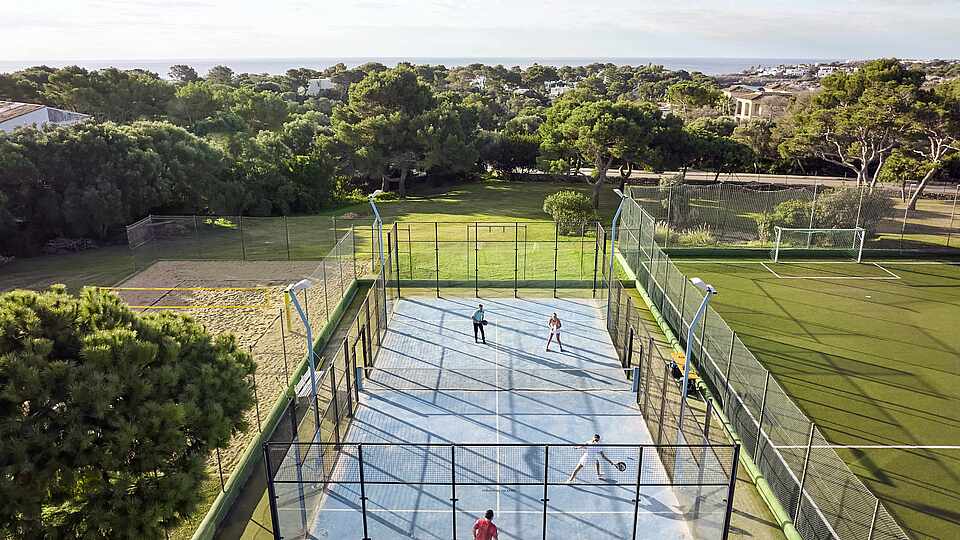
You come onto the court as men's, women's or mixed doubles. The serve is carried out from below and placed diagonally in the opponent's field. The ball must not touch the metal fence. In free play, you can use the glass or concrete wall. The scoring system is the same as for tennis.
Resorts with padel offer




What are the differences between padel and tennis?
- The way of playing:
The distance to the opponent is much shorter due to the smaller playing field. This allows you to have more frequent and longer rallies. The net playing time is therefore much longer - and fun is guaranteed. Padel is more dynamic and faster than tennis. Less focus on technique and strength, more focus on strategy - so definitely a fun sport for everyone.
- The court:
The padel court is smaller: a rectangle of 10x20m and is divided into 2 halves of play by a net, just like tennis. The court is surrounded by walls of glass and mesh, which can be incorporated into the game in a similar way to squash. The T-shaped lines on the artificial turf surface are only relevant when serving.
- The rackets:
The rackets are shorter. A padel racket is a maximum of 46 cm long and 26 cm wide. According to the official padel rules, the racket must not be thicker than 38 mm. The weight is between 340-395 grams. The hitting surface usually consists of an EVA or FOAM core surrounded by one or more other materials. Glass fibre and carbon fibre are often used.
Is padel suitable for children?
Clear answer: Yes! Especially children have a steep learning curve and thus a lot of fun. They often can't get enough of padel.
How good that padel is so beautifully simple.